The UK faces a growing imbalance between dominant US tech firms (increasingly aligned with an illiberal US administration) and rapid, illiberal AI development in China. We’ll explore how Britain can build digital sovereignty while staying an open, liberal democracy – covering AI that strengthens transparency and accountability, data as a national and individual asset, reducing dependence on overseas platforms, closing loopholes that let social media influence democratic processes, and whether open source approaches and a Digital Bill of Rights can help.
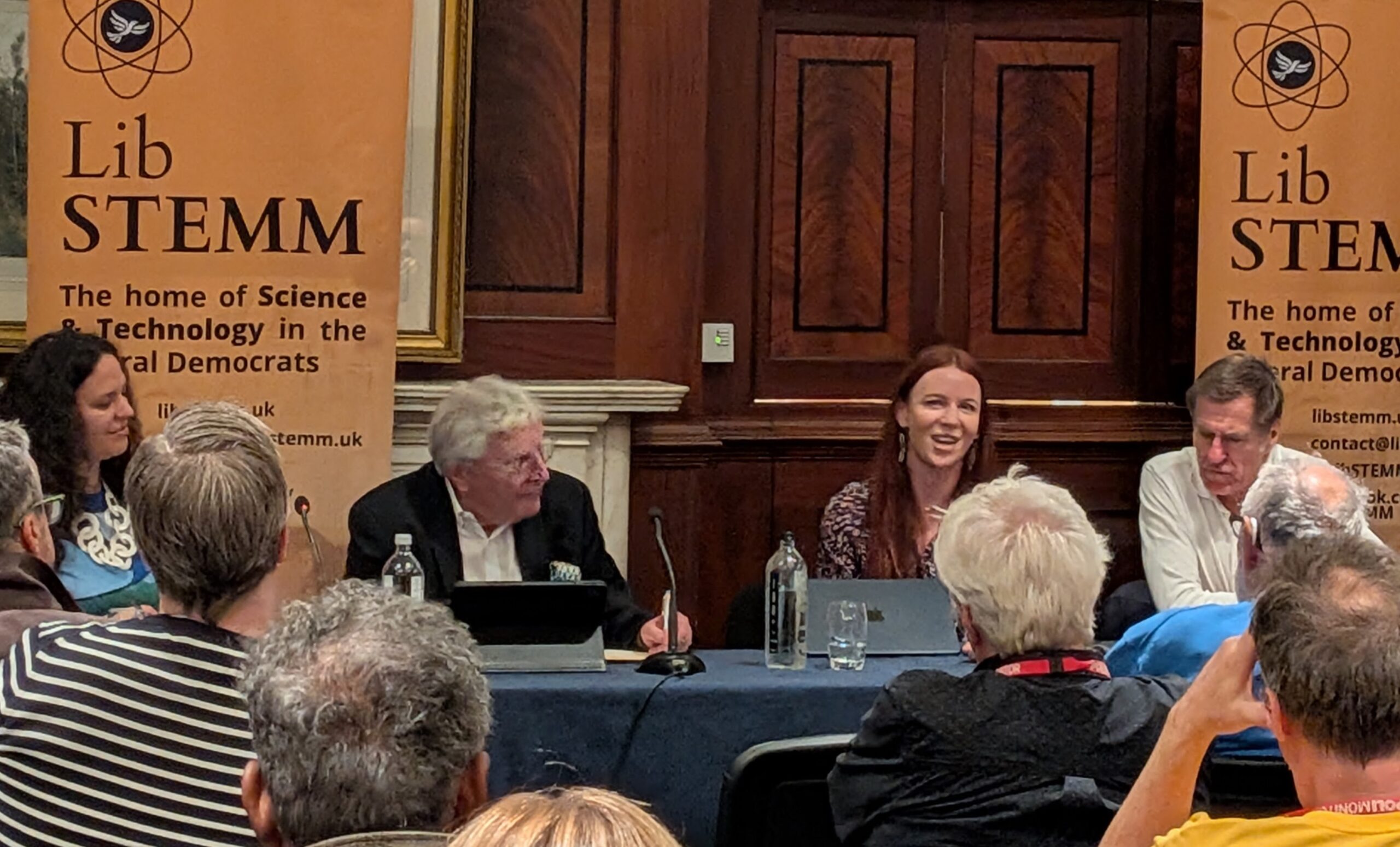
At Brighton, during the recent Liberal Democrat party conference, LibSTEMM hosted a fringe meeting discussing:
National sovereignty:
To what extent are we, as a “middle power” nation are able to shape how AI used and its outcomes for our society and economy.
We have an oligopoly of hyperscalers, some the size of countries, some with political agendas at odds with ours, how much of a threat to our national sovereignty is this?
Where do approaches like open source and data commons play a role and what lessons can we learn from the internet? What are the limitations?
How do we see US, China, Russia and the weaponisation of AI impacting our security? How does that impact the way we need to work with AI companies and what critical capabilities do we as UK PLC need to have?
The world of work
We explored the application of AI in practice at work and what power dynamic is required to deliver true productivity and prosperity in our economy considering questions such as:
How confident are we of the claims of the Hyperscale’s predications of AGI and replacement of the majority of jobs? What are the implications of this being realistic / unrealistic for how we as the UK should tackle this?
What is the role of unions and collective action to ensure AI is implemented well for real world benefit and improved services / products?
For Small to Medium sized enterprises, how are they able to use AI for productivity and help them not get tied in to one supplier?
Individual Sovereignty
How we can ensure individuals are able to retain control over how their own data identity is used and have informed trust in the AI services they use?
What role can a digital bill of rights grounded on international human rights law, play to protect people’s digital identity and provide transparency, accountability and redress? What teeth does it need? What level of data and AI literacy is required for citizens to engage with this?
What role can consumer protection play to incentivise tech and AI firms to take accountability and act for negative social and political consequences? We considered examples such as the recent high profile Meta court case and settlement in the USA, as well as the interoperability of technology and portability of our data between services, and the potential for big tech to lock us in to using their services.
- We discussed what a digital bill of rights would contain, and whether existing existing consumer protection provided sufficient safeguards against the misuse of AI or harms caused by AI use.
- We discussed AI in the workplace
- There were thoughts expressed on the idea of UK open AI models and how government can accelerate them. There is clearly interesting angle there for innovation, resilience, jobs and environment.
- It was agreed that there is work to be done on understand the data centre debate, focusing on education of local parties in particular. We need, as a country, to think about the compute power we actually need and where it needs to be.
There were many take-aways from the session, and LibSTEMM will be returning to many of the subjects covered in due course.
Panel
Helen Cross, LibSTEMM Policy Officer, an AI leader who has spent for much of her 20+ year career, designing and implementing AI and Robotics at scale, focusing on solving real world problems and adoption. She has stood twice as an MP and was a member of the Liberal Democrat Policy Committee for 6 years.
Panellists
Lord Clement-Jones is the LibDem spokesperson for Science, Innovation and Technology in the House of Lords and a leading voice on the governance of artificial intelligence. A life peer since 1998, he chaired the first Lords Select Committee on AI in 2017 and initiated the 2023 Special Inquiry into AI in Weapons Systems. He also co-founded and continues to co-chair the All-Party Parliamentary Group on AI, is a founding member of the OECD Parliamentary Group on AI, and has advised the Council of Europe on AI regulation.
Linda Griffin, VP Global Policy, Mozilla. Many people will know Mozilla as developers of the Firefox web browser. Mozilla Foundation is a non-profit building a better technology future — powered by people, open by design, fueled by imagination. They deliver people-first alternatives to today’s extractive systems. They build side by side with developers, innovators and advocates, united in the belief that a better technology future is not only possible — it’s ours to create.
Mark Curtis is a serial entrepreneur and has spent 40+ years at the intersection of design, technology, and human behaviour. He co-founded the global design agency Fjord in 2001, acquired by Accenture in 2013. For 15 years he led the creation of Accenture Life Trends (formerly Fjord Trends), an influential annual foresight report exploring how technology and society shape each other. Author of Distraction: Being Human in the Digital Age (2005), Mark has been a pioneer in digital transformation since the 1990s, helping organisations navigate emerging technologies whilst keeping human values at the centre. He has a new book being published in 2027 entitled The Future of Play is Work. He is a frequent speaker at industry conferences and advisor to executive teams on design-led business change. Today he works independently as a strategic advisor, writer and speaker, helping leaders navigate an accelerating world. He publishes and podcasts regularly as part of Full Moon (www.wearefullmoon.com).
Leave a Reply